

By Lara Lasnitzki, speech pathologist; Nechama Kazatsky, paediatric occupational therapist; and Ashley King, paediatric occupational therapist
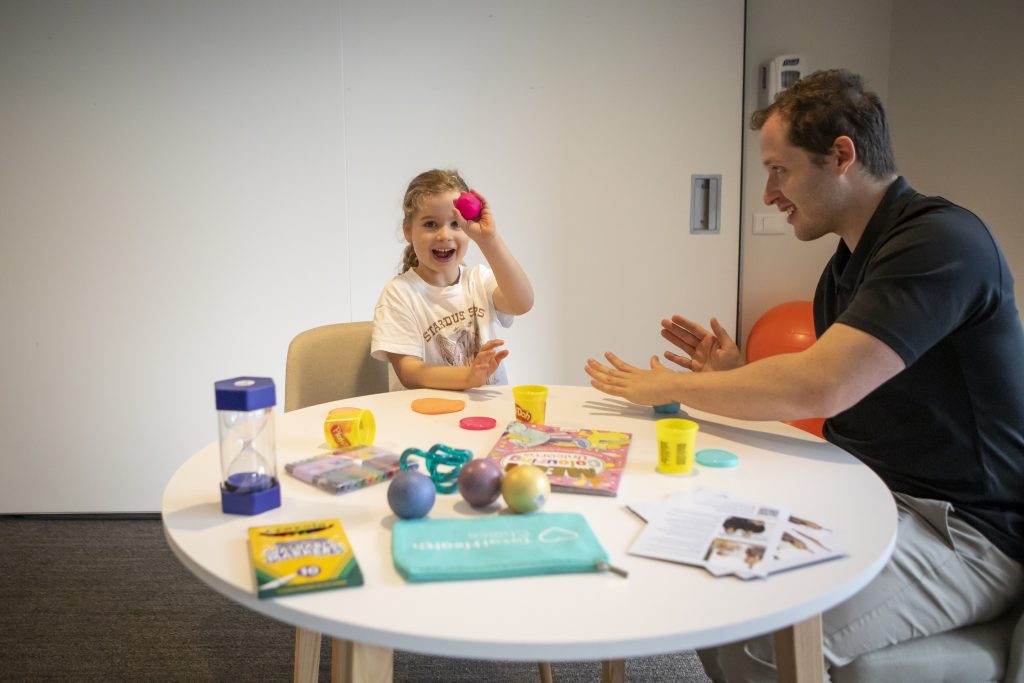
You sat in on the whole session. Your child squished playdough, played a game with a plastic toilet, and laughed most of the hour. Now you’re driving home wondering: is this therapy, or are we paying for them to play?
It’s a fair question, and you should ask it. We run these sessions, so let us show you what’s going on underneath.
Is my child just playing in therapy?
No. In play-based therapy for kids, the game is how your child practises the hard thing again and again, because they want to.
Australia’s National Best Practice Framework for Early Childhood Intervention says children learn best in the everyday places they spend time, and that therapists should support them through play and the things they’re interested in. It describes good practice as “enjoyable, play-based and incidental learning opportunities within daily routines that allow for practice”.
So every game should have a goal we can name in one sentence.
What is a speech pathologist working on during a game?
Lara
Playdough is one of the most common things I use. It’s cheap and kids love it.
First, it helps us connect. A child needs to enjoy the same thing as me before they’ll try something hard. We call that joint attention.
Then I hold the colours and the tools. That’s on purpose. If your child wants the blue, they need to ask for it, or choose between two. Depending on where they’re at, that could be a sound, a word or a whole sentence. We call these communication temptations: setting things up so your child has a reason to talk.
From there, playdough can work on almost anything:
- Pronouns. We build characters and talk about his eyes and her eyes, what he’s doing and what she’s doing.
- Action words. Roll, push, squish, cut.
- Describing. Your child makes something and tells me about it.
- Turn-taking. I have a turn, you have a turn, and we say what the other person is doing.
- Barrier games and following instructions. We put a barrier between us and give each other instructions to make something, then lift it and see if we made the same thing. It takes really specific words.
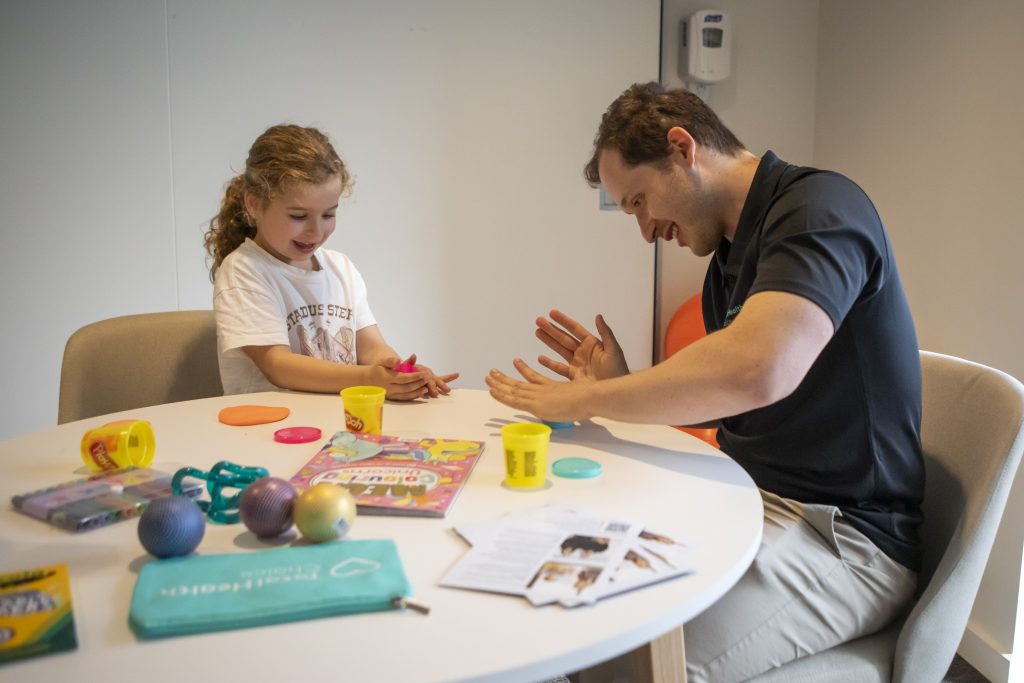
Stepping it up or helping out: If a child gets stuck on a word or choice, I model the phrase first or offer gentle prompts, like starting the word, showing the mouth shape, using a gesture, or pointing to a picture. I then fade those prompts as they build confidence. When they get it right easily, I step it up by asking for longer phrases or taking away the extra hints.
At home: we’ll give you the exact words we’re working on. If it’s action words, roll, push, squish and cut together, and say each word as you do it.
What is an OT working on during a game?
Nechama
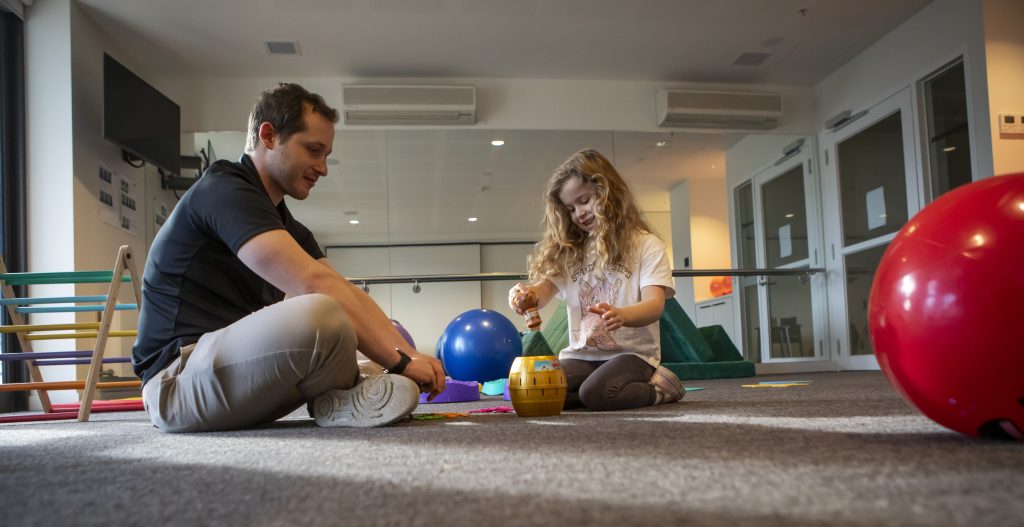
One game I pull out a lot is Catch the Poo. It’s a plastic toilet with a plastic poo. You roll the dice, pump a pretend plunger that many times, and at some random moment the poo pops up and you try to catch it. Kids of any age love it, because it’s poo.
Same game, different goal, depending on the child:
- Toileting. If we’re working on toileting, a poo game makes it easier to talk about. After a round we chat about when they last went and how they wipe.
- Two hands together. The plunger needs both hands. For children with hemiplegia, where one side of the body is weaker, a game like this gets both hands working together.
- Counting. Kids often race “1, 2, 3, 4, 5, 6, win”. We slow right down and match one number to one pump.
- Fun versus silly. Some kids go from a great time to silly in a second. This game has plenty of room for silly, so we keep playing while everyone’s having fun. If it tips into silly, nobody’s enjoying it, and the game goes away.
At home: you don’t need this game. For counting, any game with a dice works. Slow down and count each move out loud. For fun versus silly, play any game you have and stop to ask, “Are you having fun? Is everyone around you having fun?” For toileting, keep going with the plan we’ve agreed together, and keep talking about it.
How does the game get harder?
As your child gets the hang of something, we change the game so it stays a little bit hard. That’s scaffolding, and the national framework says to do it “in the least intrusive and intensive manner”.
Ashley
I use Hungry Hippos to work on winning and losing, and coping when luck goes against you. It mixes luck and skill, so there’s problem solving and planning in it too.
To step it up, I add mini games:
- Your hippo can only eat one colour.
- Eat the wrong colour and you lose points.
- Land a certain colour and you play with one hand behind your back.
Each rule adds a sudden, not-ideal moment. That’s the point. We practise coping with it here, to help build the capacity to cope when it happens at school, out in the community or at home.
At home: play with a brother or sister, or mum and dad, up to four players. Win or lose, everyone gets their turn.
What can I do this week?
Ask your therapist four questions:
- What’s the goal of this game?
- How will we know it’s working?
- How do I do this at home?
- What changes next session?
Then pick one routine, like bath time, getting dressed or dinner, and practise one goal in it. The framework’s guide for families puts it well: “Practitioners are only a small part of the week. The big changes happen in everyday moments.”
When should I raise it, or get help?
Raise it with your therapist if there are no written goals, no updates, or they can’t tell you what a game is for. You have every right to know.
Not seeing anyone yet? Raising Children Network suggests getting help with talking if your child isn’t using sentences of four or more words by age 4, is often hard for family and friends to understand, or has stopped using a language skill they once had. You can go straight to a speech pathologist, or start with your GP.
We see children for speech pathology and occupational therapy at our Malvern clinic, at home and at school. If you’re not sure what a game in your child’s session is for, ask us. We’d love to show you. Not with us yet and something’s on your mind? Send us a message or call 1800 847 847, and we’ll talk it through.
The play is the work. And you’re part of it.
Sources
- University of Melbourne for the Department of Social Services, National Best Practice Framework for Early Childhood Intervention: Everyday settings key principle, 2025. https://www.health.gov.au/sites/default/files/2025-09/the-national-best-practice-framework-for-early-childhood-intervention-practice-guidance-everyday-settings-key-principle.pdf
- University of Melbourne for the Department of Social Services, National Best Practice Framework for Early Childhood Intervention: Looks like, doesn’t look like (child-centred), 2025. https://www.health.gov.au/sites/default/files/2025-09/the-national-best-practice-framework-for-early-childhood-intervention-looks-like-doesn-t-look-like-child-centred_0.pdf
- University of Melbourne for the Department of Social Services, National Best Practice Framework for Early Childhood Intervention: Growing and learning, a guide for families, 2025. https://www.health.gov.au/sites/default/files/2025-09/the-national-best-practice-framework-for-early-childhood-intervention-growing-and-learning-a-guide-for-families.docx
- Raising Children Network, Language development: 3-4 years, accessed 19 November 2026. https://raisingchildren.net.au/preschoolers/development/language-development/language-3-4-years
- Raising Children Network, Speech disorders in children: 1-8 years, accessed 19 November 2026. https://raisingchildren.net.au/babies/development/language-development/speech-disorders
